

New Plant Species Discovered in Big Bend National Park
-
FHIST NEWS -
March 7, 2025 at 12:07 AM -
- Flora
-
467 Views -
0 Replies
A "Devilish" New Species Discovered in Big Bend National Park
This tiny, fuzzy sunflower relative has been hiding in plain sight—it represents the first new genus identified in a U.S. national park in nearly 50 years

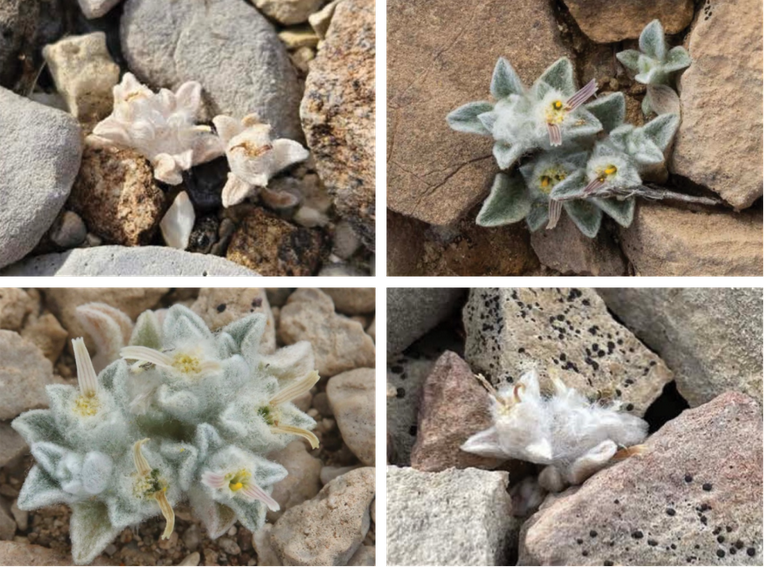
The first photo of the woolly devil made a stir among botanists when Deb Manley uploaded it to iNaturalist in March 2024. Deb Manley / Public Domain
In March 2024, Deb Manley, a volunteer in Big Bend National Park, Texas, uploaded photos of a small, low-lying plant covered in silvery fuzz to the species identification app iNaturalist. The app populates a public map with observations of plants and animals, which shows how frequently species are observed in a given area and can bring the user community together to tackle tricky identifications. Manley sparked one of those puzzles when she shared her photos of the plant, which she and other park staff had encountered on a hike. Curiosity soon gave way to excitement when users realized that the plant did not match any species known to science. Not only was this the first recorded sighting on iNaturalist, it was the first recorded sighting, period.
“It’s very rare for something so different from what we know to be found,” says Isaac Lichter Marck, a plant evolutionary biologist at the California Academy of Sciences who worked on genetic analysis of the new species. Now, one year after the initial sighting, the Big Bend species has been formally described in an article published in the journal PhytoKeys, and given the scientific name Ovicula biradiata. Informally, it’s become known as “the woolly devil,” for its fur and the “devil horn”-like rays protruding from its flowers. The discovery marks both a new species, and the first new genus found in a national park since a yellow-flowered shrub called July gold was discovered in Death Valley back in 1976.
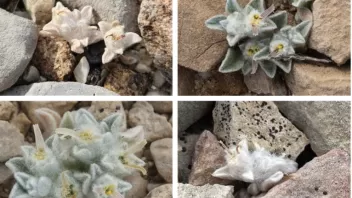
Although the woolly devil is abundant in a few small areas of the park, more research is needed to understand how to protect it. Clockwise from top left: Dana Sloan, Cathy Hoyt, Kelsey Wogan, James Bailey / Public Domain
CITATION/CREDIT: Andrew Coletti ATLAS OBSCURA