

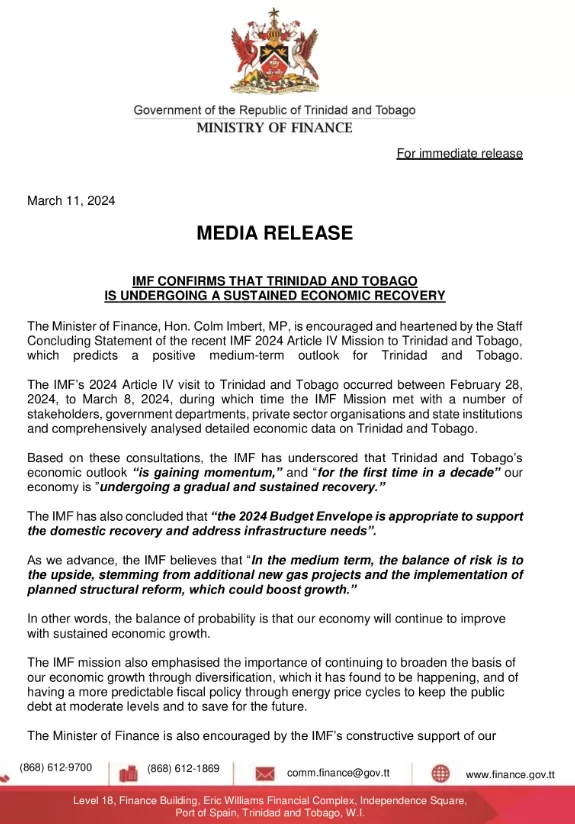
IMF CONFIRMS THAT TRINIDAD AND TOBAGO IS UNDERGOING A SUSTAINED ECONOMIC RECOVERY
-
FHIST NEWS -
March 11, 2024 at 4:10 PM -
- Finance News
-
395 Views -
2 Replies
Trinidad and Tobago: Staff Concluding Statement of the 2024 Article IV Mission
IMF STATEMENT
March 11, 2024
A Concluding Statement describes the preliminary findings of IMF staff at the end of an official staff visit (or ‘mission’), in most cases to a member country. Missions are undertaken as part of regular (usually annual) consultations under Article IV of the IMF's Articles of Agreement, in the context of a request to use IMF resources (borrow from the IMF), as part of discussions of staff monitored programs, or as part of other staff monitoring of economic developments.
The authorities have consented to the publication of this statement. The views expressed in this statement are those of the IMF staff and do not necessarily represent the views of the IMF’s Executive Board. Based on the preliminary findings of this mission, staff will prepare a report that, subject to management approval, will be presented to the IMF Executive Board for discussion and decision.
Washington, DC: An International Monetary Fund (IMF) staff team, led by Mr. Camilo E. Tovar, visited Port of Spain during February 26–March 8, 2024, and held discussions on the 2024 Article IV consultation with Trinidad and Tobago’s authorities. At the end of the consultation, the mission issued the following statement, which summarizes its main conclusions and recommendations.
A gradual and sustained economic recovery
- For the first time in a decade, Trinidad and Tobago is undergoing a gradual and sustained economic recovery. Real Gross Domestic Product (GDP) rebounded in 2022 and is estimated to have further expanded by 2.1 percent in 2023. This reflects the strong performance of the non-energy sector, which was partially offset by a contraction in the energy sector. Inflation has declined sharply to 0.3 percent in January 2024, after peaking at 8.7 percent in December 2022, mainly due to declining food and imported goods inflation. Banks’ credit to the private sector continues to expand and the financial sector appears sound and stable. The current account is estimated to have remained in a surplus in 2023, and foreign reserves coverage is adequate at 8.3 months of prospective total imports.
- The fiscal balance in FY2023 was broadly in line with the budget. The overall fiscal deficit is estimated at 1.1 percent of GDP in FY2023, 0.2 percentage points better than initially budgeted. This reflects higher non-energy revenue and lower than budgeted capital expenditure. Central government debt increased to 54.3 percent of GDP in FY2023 (from 50.7 percent of GDP in FY2022) and public debt reached 70.9 percent of GDP in FY2023 (from 67.0 percent of GDP in FY2022). Public financial buffers remained strong with total assets in the Heritage and Stabilization Fund at US$5.5 billion (19.2 percent of GDP) by end-FY2023.
Positive outlook with some uncertainties
- Economic growth is projected to gain momentum in 2024. Real GDP is expected to expand by 2.4 percent in 2024, supported by the non-energy sector and new energy projects coming onstream—which will help offset the structural decline in energy production. Over the medium term, the delivery of several planned natural gas projects is expected to boost growth in the energy sector, while supporting economic activity in the non-energy sector. Inflation is projected to hover around two percent in line with international prices. [Read More]
Maintaining fiscal discipline while strengthening the fiscal framework
- The FY2024 budget envelope is appropriate to support the domestic recovery and address infrastructure needs. IMF staff estimates the fiscal deficit will widen to 2.7 percent of GDP in FY2024. This reflects lower energy revenues due to declining prices and domestic production, increased capital spending, and a higher wage bill—due to the long-standing public wage settlement with some unions. The planned capital spending would help address the country’s infrastructure needs and boost growth. IMF staff recognizes that the proclamation of the Procurement and Disposal of Public Property Act in April 2023 will enhance the legal and institutional framework for transparent and competitive public procurement. It will also help improve the efficiency and quality of public spending. [Read More]
Maintaining consistent monetary and exchange rate policies
- IMF staff encourages the authorities to maintain consistent policies to support the current exchange rate arrangement. The Central Bank of Trinidad and Tobago (CBTT) has kept its repo policy rate fixed at 3.5 percent since March 2020 to support the economic recovery. With the S. monetary policy tightening, the US-TT interest rate differentials widened. While these differentials have narrowed more recently, they incentivize potential capital outflows. Although this risk currently remains contained, the CBTT is encouraged to remain vigilant and stand ready to increase its policy rate if this risk intensifies. [Read More]
Toward a modern and resilient financial sector
- The authorities need to remain vigilant to potential vulnerabilities in the financial system. While the financial system appears sound and resilient, it faces potential vulnerabilities emanating from high sovereign exposures and from interconnectedness. Closely monitoring financial sector risks is warranted, including those related to climate and cyber-security.
- The authorities are encouraged to continue enhancing the financial regulatory and supervisory framework. IMF staff welcomes progress toward strengthening the resilience of the banking and insurance sectors in line with the recommendations of the 2020 Financial System Stability Assessment (FSAP). [Read More]
Advancing structural reforms to address long-term challenges
- Trinidad and Tobago needs all its engines to boost growth and secure a more diversified, green, resilient, and inclusive economy. The authorities’ efforts to foster the competitiveness of the energy sector and boost future natural gas production (e.g., the restructuring of the country’s main liquified natural gas facility) will help support economic growth and provide the financial resources needed for the transition to a low-carbon economy. However, it is important to strike a balance between leveraging the country’s maturing energy sector and providing conditions to foster growth of the non-energy sector. This will help shield the economy from global energy market volatility and green energy transition risks. [Read More]
Enhancing the adequacy of statistics
- The authorities’ sustained efforts to improve the quality, timeliness, and the coverage of macroeconomic statistics are welcome. Transforming the Central Statistical Office into an independent National Statistical Institute would help strengthen the country’s institutional capacity. Additional efforts are needed to address the large errors and omissions in the balance of payments and to collect and disseminate comprehensive climate- and GHG emissions-related data, including at the industry level. [Read More]
The IMF team is grateful to the authorities and the broad range of public and private sector counterparts for their warm hospitality, cooperation, and constructive discussions.
-END-
Replies 2