Journey Through Time: A Brief Tour Of 30 Yrs Of HTML
-
Sapodilla -
March 8, 2024 at 12:33 AM -
594 Views -
0 Replies

fter the release of the first Hypertext Markup Language version on November 3, 1992, which is also commonly known as HTML, it has come a long way since its introduction.
Although it was released in 1992, it took a long time for HTML and the World Wide Web to gain traction. The World Wide Web only took off in 1995/96. Before that it was more for geeks, programmers or people who were enthusiastic about technology.
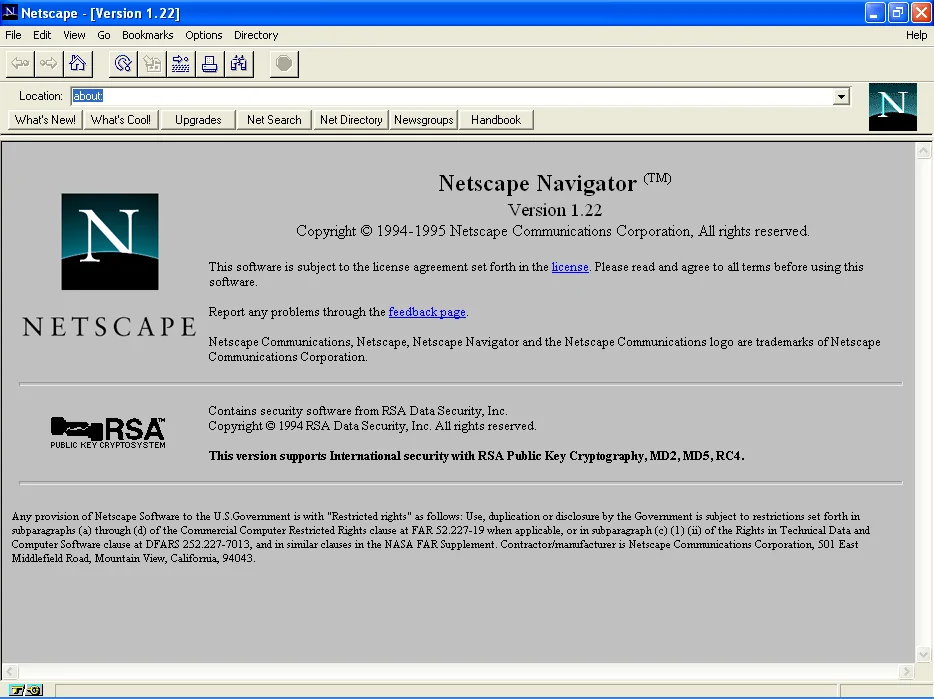
Netscape Navigators 4 on Windows 95
Since setting it up alone required a lot of time and patience, surfing the World Wide Web was an adventure in itself. Creating websites wasn't really a thing. However, if you wanted to create commercial applications, you still had to choose between the web, the French Minitel or the German BTX.
Creating a 90s style website
For the most part, the biggest challenge in the mid-90s was finding someone to host the website. Registering a domain was a completely different story compared to today. Assuming you had your own server or found someone who would host your own website, they would probably only grant you FTP access at the time, which would allow you to create HTML code and the GIF images that were common at the time save your own website.
HTML 1.0, 2.0 up to 3.2 were relatively simple. Even very simple, you could say. JavaScript only saw the light of day in 1995 and even then it took a while until it was adopted in browsers, at that time mainly Netscape and Internet Explorer. The same also applies to the cookies that came onto the market in 1994. Almost every browser displayed a message asking the user to accept cookies - déjà vu? So if someone allowed you to use their web server software on their Unix machine, you could just host a few HTML files and images and you would be a webmaster. However, not something that would really excite today's Internet users.
To create an interactive website that users can not only browse but actually interact with, such as through chat, you would probably use CGI (Common Gateway Interface) or create your own web server. Setting up your own web server like this was not uncommon at the time, but most people tended to use CGI. What CGI used to do and still does today is that it forwards HTTP requests to the respective application and the application would return the header, HTML code or content. Perl, C and C++ were the most commonly used languages for creating a CGI application for the web server. However, it was very cumbersome because everything that was interactive had to be done on the server. Since there were no cookies before, most session handling and management was done through the path component of the URL using unique identifiers for the user or session.
Given the performance of computers in the mid-90s and their CPU clock speeds between 25 and 180 MHz, running interactive web servers was very expensive. In this regard, SPARC CPUs and its systems from Sun Microsystem were often used. But even they were anything but cheap back then.
1995/96 and the boom of the World Wide Web
The years 1995/96 were milestones for the World Wide Web and the Internet as we know it today. As usage increased, many services flourished. From free web hosts, Yahoo, to auction platforms like eBay, to online shops like Amazon. In particular, software such as Microsoft Frontpage, Sierra's WWW Artist and many others have made it easier for people to create their own website and then upload it via FTP.
Newer programming languages such as PHP and Microsoft Active Server Pages made it much easier to create applications for the World Wide Web. Cookies and JavaScript also enabled significantly greater interactivity, although browsers were quickly overwhelmed by the execution of JavaScript and browser crashes were common. Not to mention Java applets and the then ever-popular Flash Player from Macromedia, which was released in 1996. CSS (Cascading Style Sheets) were also released in 1996.
At that time, the creation of websites still consisted exclusively of table layouts. Currently, numerous tables, tables with tables, have been nested together. There were no Internet updates, so it was not unusual to come across relatively outdated web browsers at the time. Regarding the browser wars from 1995 to 1998, cross-browser support had been a major problem. Therefore, using tables was the safest way to design a website. Except for the animated GIF images that told the user which browser the website was created for. Element styles were simply style attributes. If you wanted to use unusual styles, you ultimately had to use images and images packaged in tables. By and large, creating websites back then was a game with tables.
Given the extremely slow speeds in 1995 to 1998, which were mostly 56kb or 7 kilobytes per second, images on websites took what felt like an eternity to load. It happened that the loading time of an animated GIF, which, for example, advertised your favorite browser, usually took 2 seconds. So with a lot of images, it wasn't unusual to have to wait up to 30 seconds or more for a web page to fully display. Content delivery networks didn't matter and latency added to the "experience". And that was indeed, literally, an experience.
1997 bis 2000
Macromedia, which includes Dreamweaver, Fireworks and Flash, quickly became the solution of choice for many professional webmasters. This is despite the fact that with the introduction of CSS, JavaScript, PHP, as well as many other programming languages focused exclusively on the web, creating websites became purely a software development or engineering task.
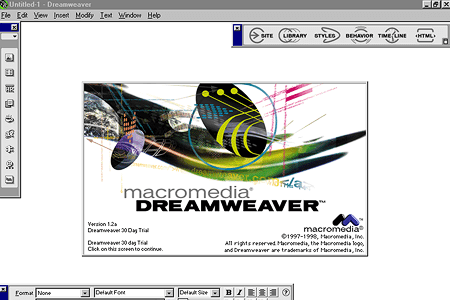
Macromedia Dreamweaver from 1997/98
However, until the turn of the millennium in 2000, many websites continued to be designed with table layouts and it was not uncommon to see old browsers such as Internet Explorer 3.0 in circulation. As websites have become more interactive and media-rich over the years, this has meant developers and users have to deal with plugins such as Flash, Java applets or Real Player. For the user, this meant they had to constantly update plugins or install new plugins. And that with download speeds that were well below acceptable levels even for those times.
Real Player
At the end of the 90s, the first video and music streaming services appeared, although even broadband users with more than one megabit per second couldn't really enjoy anything. In addition, the software and products from Real Networks were very expensive compared to today's open source world.
WML in 1998 – The birth and death of the mobile web
The Wireless Application Protocol (WAP), which used the Wireless Markup Language (WML), could organize different pages into a set of cards. This reduced the amount of data to be transferred as it allowed multiple pages to be transferred to the user at the same time. This has a bit of a feel to today's modern front-end frameworks - déjà vu again? However, given the galactic prices of mobile phone providers, the WAP quickly became a frightening experience as it could generate very high bills in a matter of seconds. The user liked it, to say the least, but not so much.

Nokia 7110, the world's first WAP phone
As a result, the WAP and WML died as quickly as they were born. Although technically very interesting, the commercial environment in which they were used ultimately led to their downfall. More powerful mobile browsers such as Mobile Internet Explorer on the Pocket PC, Windows Mobile and other mobile browsers make WAP unnecessary. Palm, Nokia, and many others developed multiple approaches to the mobile web, but most, if not all, failed.
2002 – The year of Windows XP, IE 6 and Firefox
The year 2002 marked the birth of Windows XP, Internet Explorer 6 and Firefox. After the dot-com story in 2000, the Internet and the Web matured. Commercial services such as online shops, hotel and flight booking sites are springing up like mushrooms. Through the further development of JavaScript, CSS and HTML with HTML 4.01, the web developed into what we also know as “Web 2.0”. For the first time, many browsers were now able to display relatively complex user interface components such as calendars, auto-completed text fields, interactive tables, maps and much more.

Phoenix 1.0
With the appearance of Google Maps, for example, the modern "Web 2.0" showed its ability to provide comprehensive applications that were previously only possible as desktop applications such as Microsoft AutoRoute. Wikipedia, as an interactive encyclopedia, now had sufficient database, storage and computing capacity with server farms to operate large interactive websites.

Google Maps from Google Inc. in 2005
JavaScript was suddenly able to manipulate the entire DOM, browsers had enough power to display complex pages, and CSS made web pages more convenient to design. Email applications, which previously only ran on the desktop, were primarily web based. With every improvement in HTML, CSS, and JavaScript, the web became more and more in line with the capabilities of desktop applications.
2008 – The rebirth of the mobile web
After its birth in the mid-90s, the mobile web has essentially always had two significant problems that prevented it from continuing to grow and become something that people would use on a daily basis
- The galactic prices of mobile operators
- Websites that are not optimized for small screens
Google's Android saw the light of day. With this, more and more webmasters and developers began creating mobile websites. In the early days of the mobile Internet, mobile devices were often redirected to stripped-down mobile websites. Often under domains where the WAP service was retained and slowly converted to the new mobile web.
T-Mobile G1 with integrated web browser
Apple and Google have finally mastered what Nokia once failed to achieve: making the mobile Internet accessible to the masses. The infamous mobile websites also slowly disappeared when CSS media queries were introduced in 2012, allowing websites to adapt to different screen sizes, devices and shapes. In addition, mobile browsers have also become more powerful, as have the underlying devices.
2020, 2021, 2022 ...
At the beginning of 2020, the web and web browsers had solved almost all of the challenges of the past. Browsers could now stream videos, edit images and videos, adapt to devices, and run virtually any application within the browser itself. This went so far that entire operating systems that were ported to WebAssembly could be run in the browser. HTML, CSS, JavaScript, WebAssembly and a whole host of native APIs are the main components of modern applications today. HTML has made it beyond the browser as it has become a common standard for desktop applications and mobile apps as well with frameworks like React, Electron and others.
In many operating systems such as ChromeOS, Android, iOS and Windows, the browser is becoming increasingly integrated into the system. In addition, more and more applications are making massive use of the web and HTML to display content or provide services. With the advent of Software-as-a-Service, modern corporate applications are now quickly transitioning to the browser, ultimately relieving the user of the installation burden and complicated licensing.
Challenges that still exist
Testing different browsers was very tedious back then and still is today. Even though Internet Explorer is now a thing of the past, the variety of mobile devices, different form factors and the different support for HTML5 remain a challenge. With Chrome, Safari and Firefox, the differences between the browsers on both desktop and mobile devices are no longer as significant as they once were with Internet Explorer and Netscape Navigator.
Today's web applications have to deal more with mobile networks, devices that move across multiple networks and connections that can suddenly break due to a loss of network coverage.
With the introduction of the x-index also came the popup windows. With centered layers which blocked the user from accessing the actual content of the website.
Due to the ever increasing complexity of HTML, CSS and JavaScript, it is becoming increasingly difficult for software developers to create web developments that comply with the web standard. Many of today's websites easily exceed 5 megabytes or more, so the performance problems of the past have not yet been solved today.
-END-
Credit: WCS Playground
What do you think about the history of HTML?
Share your thoughts in the comments and/or the discussion forum!.